

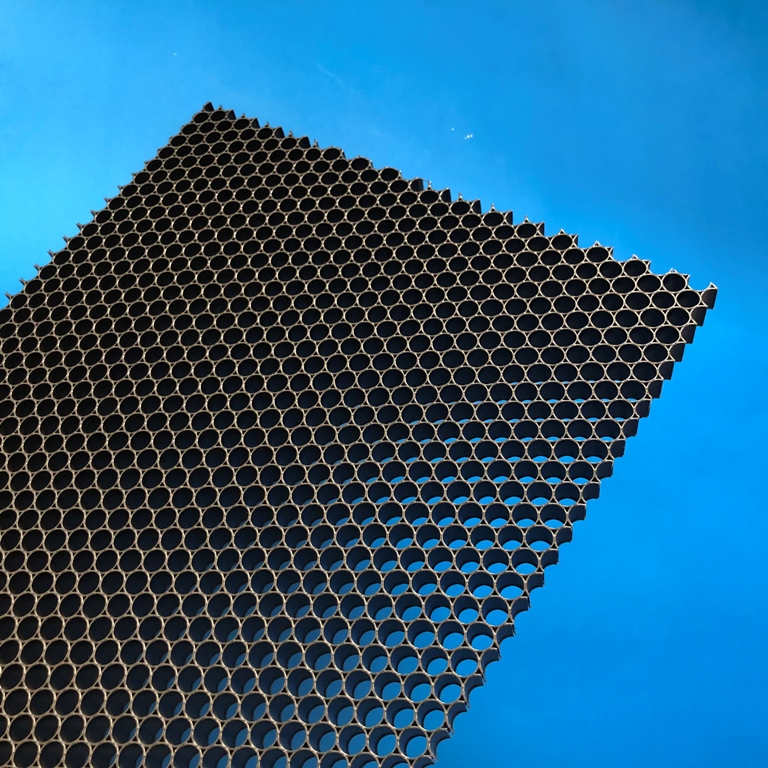
Both are made of PP sheets, but their node bonding methods create big differences in strength, processability and service life. Our product is a hot-melt-welded PP honeycomb core, with no extra adhesive at the joints.
1. Bonding Principle
Glue-bonded PP honeycomb: Joined by external adhesive. It is heterogeneous bonding. The glue-PP interface is an inherent weak point.
Hot-melt welded PP honeycomb (our type): PP melts and fuses together at high temperature. It is homogeneous self-fusion, with no third-party binder.
2. Performance Comparison
✅ Bonding strength: Glue-bonded cores easily delaminate at glue interfaces under tension or vibration. Hot-melt fused joints are integrated. Breakage happens in the PP material itself instead of joint separation, with better shock and bending resistance.
✅ Resistance to moisture, chemicals & thermal cycling: Adhesive swells, softens or hydrolyses when exposed to water, grease, weak acid/alkali. Different thermal expansion rates between glue and PP cause gradual debonding. Hot-melt honeycomb is pure PP. No glue weak links. It stays stable under humid conditions and temperature changes.
✅ Dimensional stability: Glue curing brings shrinkage and deformation. Honeycomb cells tend to twist and panels warp. Hot-melt structure has no glue shrinkage. Cell shape stays neat, and finished panels keep good flatness after lamination.
✅ Low volatiles & clean cutting: Glue releases VOCs and crumbles into fine debris during cutting. Hot-melt cores have no glue additives. Cutting surfaces are clean with only PP chips.
✅ Heat resistance & reprocessability: Glue fails quickly beyond its temperature limit. It cannot stand secondary hot pressing or thermal lamination. Hot-melt joints are heat-resistant and compatible with hot composite processes.
✅ Ageing performance: Adhesive ages irreversibly and fails earlier. Hot-melt honeycomb ages consistently with PP raw material for a longer service life.
3. Limitations of Hot-Melt Version
Higher equipment and production cost than glue-bonded options.
Demanding process control; improper parameters cause weak welding.
Lower maximum production throughput.
4. Summary
Glue-bonded PP honeycomb relies on adhesive; glue seams are its main failure point. Hot-melt welded PP honeycomb achieves monolithic PP fusion without glue interfaces. With the same PP raw material, it provides superior strength, media resistance and long-term stability.