

As one of the most versatile thermoplastics widely used across packaging, automotive, construction and composite panel sectors, polypropylene (PP) remains a foundational material for thousands of industrial manufacturers. For buyers and processors relying on PP resin — especially producers of PP honeycomb core and composite honeycomb panels — tracking polypropylene raw material costs is critical to stable budgeting, quoting and supply chain planning. In 2026, PP price trends continue to swing amid volatile upstream markets, creating uncertainty for procurement teams worldwide. This article breaks down the current PP market landscape, major cost drivers, pricing transmission logic and practical purchasing guidance for industrial buyers.

1. Latest PP Market Overview: Crude Oil, Propylene and Finished PP Resin
It is essential to separate three closely linked pricing layers when analysing PP resin prices: crude oil, propylene monomer and finished polypropylene.
Crude oil acts as the root feedstock benchmark. Fluctuations in global oil prices set the baseline cost for all petrochemical derivatives, but crude price moves do not translate to PP prices in a one-to-one ratio. Propylene, the direct monomer feedstock for PP production, is the immediate cost driver. Propylene can be produced via steam cracking of naphtha or refinery fluid catalytic cracking. Regional supply tightness of propylene often pushes PP prices higher even when crude stays relatively stable.
Finished PP resin prices are then determined by propylene costs plus plant operating expenses, production margins, logistics and regional demand. Different PP grades — homopolymer, copolymer and high-impact grades — trade at different premiums. For manufacturers of PP honeycomb panels, low-melt and extrusion-grade PP, which is formulated for continuous sheet forming and core expansion, follows its own sub-market pricing trend, sometimes diverging from general-purpose PP.
2. Four Core Factors Pushing Polypropylene Raw Material Costs Higher
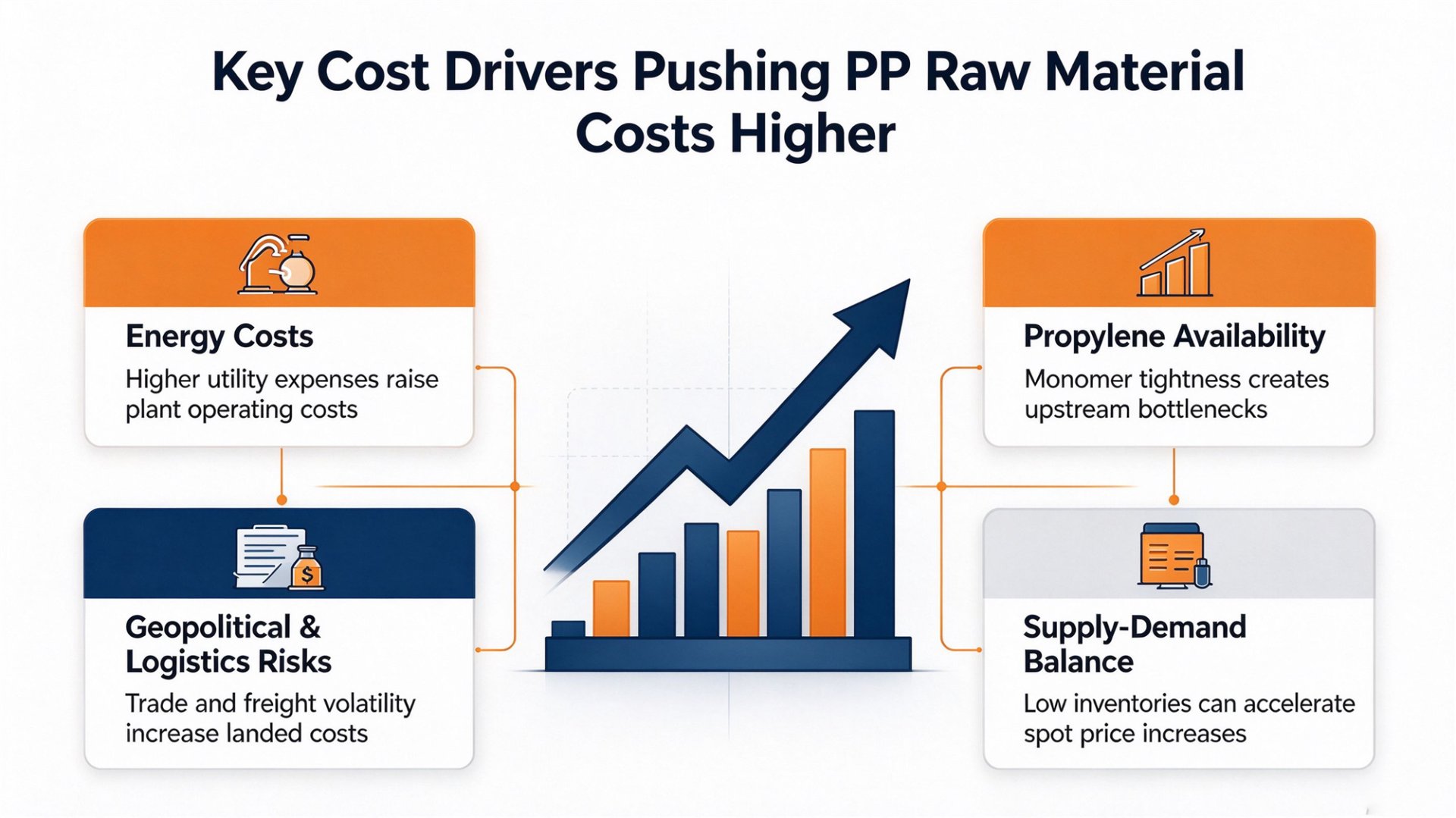
Energy costs
Natural gas and electricity are major overheads for petrochemical crackers and PP polymerisation plants. Higher energy rates directly lift production operating costs. Energy price spikes can force producers to reduce operating rates, further tightening available resin supply.
Propylene monomer availability
Propylene supply is constrained by cracker maintenance schedules, limited new propylene-focused capacity and competing demand from other downstream sectors such as acrylonitrile and propylene oxide. A shortage of propylene monomer creates a bottleneck: even if PP demand is moderate, resin prices climb.
Geopolitical and logistics risks
Cross-border trade restrictions, shipping congestion, freight rate volatility and port delays add extra landed costs for imported PP resin. Regional trade imbalances also create price gaps between Asia, Europe and North America, making global sourcing strategies harder to predict.
Supply and demand balance
Seasonal demand surges, scheduled plant turnarounds and unexpected shutdowns quickly shift the supply-demand balance. When inventory levels of PP resin across distributors and converters run low, spot market prices rise faster than contract prices.
3. Why Higher PP Raw Material Costs Do Not Always Fully Pass Through to End Markets
A common misconception is that every increase in propylene or crude oil prices will be fully reflected in finished product prices. In practice, price transmission is partial and delayed.
Many large PP producers maintain long-term supply contracts with fixed pricing formulas, which smooth out short-term spot volatility. Downstream converters also absorb part of the cost squeeze by compressing profit margins, especially in competitive segments where end customers resist price hikes. Substitution pressure also limits full pass-through: buyers may switch to alternative polymers or lighter composite structures if PP-based solutions become too expensive.
In some cycles, converters will prioritise order retention over margin protection. This creates a lag effect: raw material costs rise first, and price adjustments for semi-finished and finished products follow weeks or months later.
4. Impacts on PP Honeycomb Panel Manufacturers and Industrial Buyers
For businesses working with PP honeycomb core and composite honeycomb panels, polypropylene resin is the dominant raw material, so PP price trends directly shape production economics.
A rise in PP resin costs increases the material cost base for extruded PP sheets and honeycomb core forming. Unlike finished goods with many non-material cost components, honeycomb structures have a high raw material proportion. When resin prices jump, the cost gap between quotation and actual production cost can widen rapidly if quotes remain valid for too long.
This is where supply chain transparency matters. Unstable PP pricing creates risks for both panel manufacturers and their industrial customers. Without clear raw material escalation clauses, either the fabricator bears unexpected losses or the buyer faces unplanned price revisions mid-order. Stable, traceable sourcing of extrusion-grade PP and predictable lead times become key competitive advantages for honeycomb composite suppliers.
Achieving consistent product quality and reliable delivery under volatile resin markets depends heavily on two pillars: a resilient PP supply network and open communication around raw material index-linked pricing. Manufacturers with well-managed upstream visibility can better protect production schedules and avoid sudden order disruptions for their industrial clients.
5. Practical Procurement Advice for Industrial Buyers
Set reasonable quotation validity terms
Avoid accepting open-ended price quotes. Agree on clear validity windows, and add standard raw material adjustment clauses tied to recognised PP resin price indices. This protects both parties from sudden market swings.
Build dynamic inventory planning
Avoid overstocking resin at price peaks, but maintain safety stock to cover lead times and plant outage risks. Work with suppliers to share forecast demand so producers can allocate capacity ahead of busy periods.
Establish regular supplier communication
Schedule periodic market reviews with your resin or composite panel suppliers. Ask for updates on cracker maintenance, propylene availability and logistics constraints, rather than only reaching out when placing orders. Early visibility helps you adjust project timelines or budgets proactively.
Develop long-term strategic partnerships
Short-term spot buying may look attractive during price dips, but it carries higher supply disruption risk. Long-term cooperative agreements with reliable PP and honeycomb panel suppliers usually deliver more stable pricing and priority allocation during tight markets.
Closing
2026 polypropylene price trends are shaped by the interplay of crude benchmarks, propylene monomer supply, energy costs and global trade conditions. Raw material cost increases do not always flow smoothly down the value chain, but for PP honeycomb core and composite panel applications, resin cost remains the single largest variable in total manufacturing cost.
For industrial buyers, success does not come from chasing the lowest spot price alone. It comes from understanding the upstream PP market, designing flexible commercial terms, and partnering with suppliers who maintain transparent pricing systems and robust supply chains. In a volatile resin market, visibility and predictability are just as valuable as competitive pricing.