

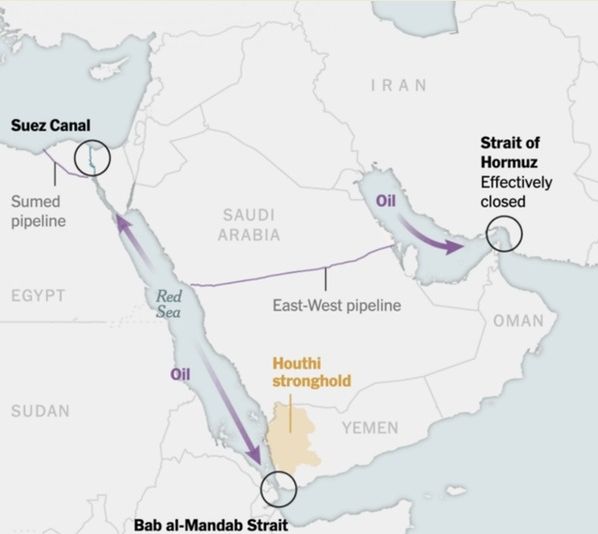
In recent months, continued Red Sea shipping security risks have been turning a waterway risk in the Middle East into a cost battle between Chinese industrial exporters and buyers in Europe and the Middle East. Shipping lines have successively raised surcharges for oversized and heavy cargo, with the ocean freight premium for extra-long and extra-wide industrial plates and heavy machinery being especially obvious. For B2B buyers purchasing large industrial plates and heavy equipment, one reality must be faced directly: looking only at FOB cargo value is no longer enough. Ocean freight surcharges and port delay risk costs are becoming variables that cannot be ignored in TCO calculation.
I. Freight Volatility Is Moving from “Broad Increases” to “Structural Divergence”
The Red Sea route risk has not transmitted to all cargo types in the form of a uniform rate increase. On the contrary, it has brought a round of structural freight rate divergence—rate volatility for standard container cargo remains within a controllable range, but oversized and heavy cargo surcharges have jumped significantly.
The reason is not complicated. Extra-long and extra-wide industrial plates—such as wide plates after uncoiling hot-rolled/cold-rolled coils, shipbuilding steel plates, and thick plates for wind turbine towers—as well as heavy machinery and equipment, themselves have special requirements for deck area, hold capacity, and loading/unloading equipment. The longer voyage caused by Red Sea diversions around the Cape of Good Hope directly squeezes shipping lines’ effective capacity turnover. Shipping lines give priority to protecting space utilization for standardized container cargo, while the supply of non-standard space for oversized and heavy cargo shrinks more sharply. Under this supply-demand imbalance, shipping lines use higher out-of-gauge surcharges and heavy cargo surcharges to screen cargo, and industrial oversized cargo bears the brunt.
This means that on the same Asia-Europe route, the actual freight rate increase borne by industrial plates and heavy machinery may be far higher than the average level reflected by container freight rate indices. If buyers still use standard container freight expectations to calculate the landed cost of oversized equipment, the budget deviation may be considerable.
II. TCO Calculation Needs Two New Cost Categories
The traditional TCO calculation framework for industrial procurement usually revolves around cargo value, tariffs, domestic logistics, and installation and commissioning. Against the backdrop of continued Red Sea risk disruption, we recommend that B2B procurement teams add at least two categories to their cost models.
First, an ocean freight surcharge category. The surcharges charged by shipping lines for oversized and heavy cargo are increasing in variety, including but not limited to out-of-gauge surcharges, heavy cargo surcharges, rerouting bunker surcharges, and peak season space premiums. These costs are often finally locked only after booking confirmation, and differences between shipping lines and voyages are significant. When comparing prices, buyers should not only compare the base ocean freight rate. They should require freight forwarders or shipping lines to provide all-in quotes including surcharges, and incorporate the historical fluctuation range of surcharges into the budget buffer.
Second, a port delay risk cost category. The uncertainty brought by Red Sea risk is not only reflected in freight rates, but also in schedule reliability. Longer voyages caused by diversions and the knock-on effects of port congestion make the port stay time for oversized cargo at destination highly uncertain. Demurrage, storage fees, port stacking fees, and idle labor costs caused by delayed equipment arrival at the site should all be quantified and reserved as risk costs. For schedule-sensitive industrial projects, the accuracy of port delay risk cost calculation sometimes affects project profitability more than the freight rate itself.
III. Splitting Orders and Multi-Port Batch Shipments: From Contingency Strategy to Standard Configuration
Facing the dual pressure of rising freight rates and schedule uncertainty, many industrial buyers have begun to adjust their shipping strategies. One of the most noteworthy changes is: splitting what was originally one consolidated oversized order into multiple batches and multi-port shipments.
The logic of this strategy is not complicated. Splitting extra-long, extra-wide plates or heavy equipment into multiple relatively standard cargo units can reduce a single shipment’s dependence on non-standard space, thereby gaining greater scheduling flexibility when space is tight. Multi-port shipping can disperse the concentrated risk brought by congestion or schedule delays at a single port—even if one batch at one port is delayed, the arrival rhythm of other batches can still maintain the basic progress of the project.
Of course, splitting orders is not without cost. Splitting means lower volume per shipment, which may lose some volume bargaining power; multi-port operations also increase the complexity of freight forwarder coordination and domestic port consolidation. Therefore, we recommend that buyers consider this strategy under the following conditions: a single batch has high cargo value and is schedule-sensitive, the destination port has congestion risk, or current route out-of-gauge surcharges have already significantly eroded profit margins. In these scenarios, the scheduling flexibility benefit brought by splitting orders often covers the coordination cost added by batch shipments.
IV. Practical Recommendations for Industrial B2B Buyers
Given the current Red Sea route freight volatility, we recommend that buyers of large industrial plates and heavy equipment adjust their procurement execution rhythm at the following three levels:
At the inquiry stage, make surcharge transparency a mandatory condition for selecting suppliers. Require suppliers or freight forwarders to itemize ocean freight, out-of-gauge surcharges, heavy cargo surcharges, and estimated port delay risk exposure in the quotation. Refuse vague “one-price” quotes. Only all-in price comparison can reflect the real difference in landed cost.
At the contract stage, set a reasonable price adjustment mechanism for freight volatility. For heavy equipment or large-volume plate orders with long delivery cycles, agree in the procurement contract on trigger thresholds and sharing ratios for freight surcharges, so that when shipping lines unilaterally raise surcharges, the entire cost is not borne by the buyer.
At the execution stage, maintain at least two alternative ports and one alternative route plan. The direction of the current Red Sea situation remains uncertain. Dependence on a single port and a single route is very fragile in the face of risk events. The ability to split shipments across multiple ports is itself an asset of supply chain resilience.
Red Sea route freight volatility is forcing industrial procurement to shift from “comparing cargo value” to “comparing full-chain cost.” For B2B buyers of large plates and heavy equipment, whoever can more quickly incorporate surcharges and port delay risk into the TCO calculation framework will be better able to protect profit margins in this round of cost escalation. Splitting orders and multi-port batch shipments may no longer be merely contingency measures; they are becoming standard capability configurations for cross-border industrial procurement.